Operations Strategy Consulting: Building a More Efficient and Scalable Business Model
Build a more scalable business with clearer processes, stronger ownership, and better visibility through practical operations strategy consulting.
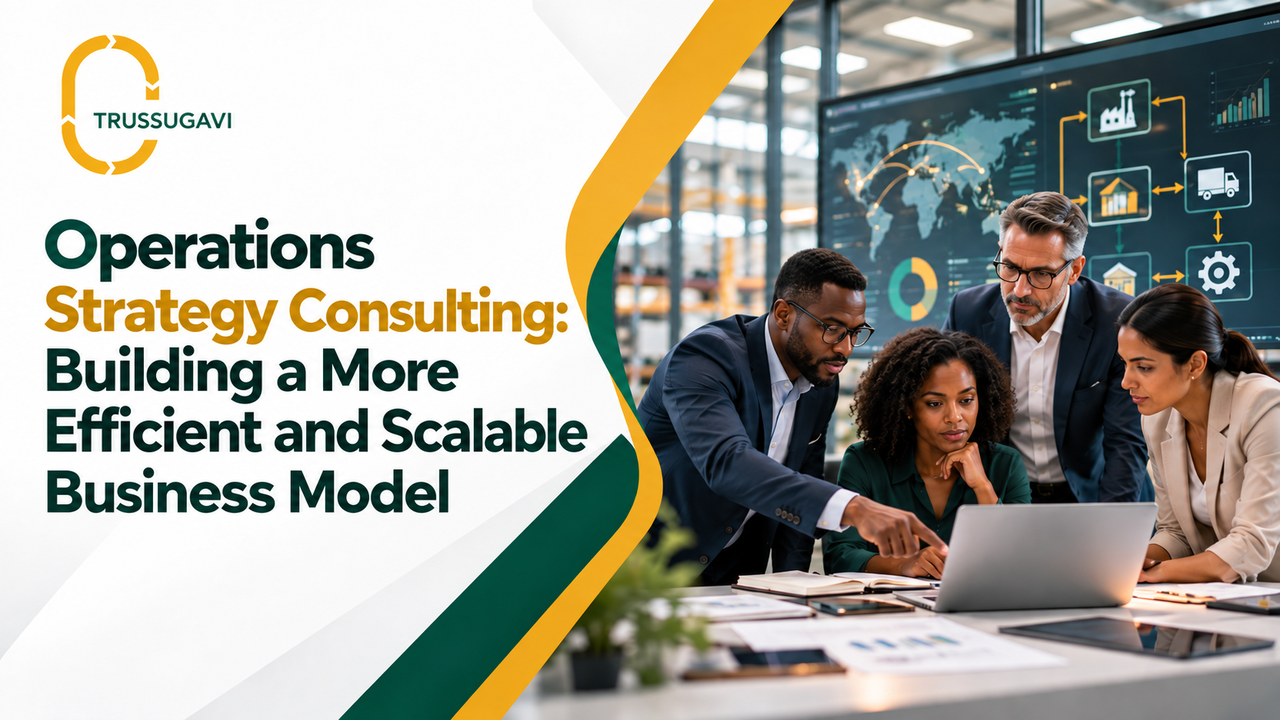
Most businesses do not fail because the idea was wrong. They stall because the operating model underneath the idea was never built to carry more weight. Every new customer, market, or product line adds pressure to processes that were only ever designed for a smaller version of the company. That is where operations strategy consulting earns its place not as a one-time audit, but as the discipline of building an operating model that gets stronger as the business grows instead of weaker.
At Truss Ugavi, we work with growth-stage businesses, manufacturers, distributors, and public agencies that have outgrown the systems holding them together. The pattern is almost always the same: work depends on memory instead of process, ownership is unclear, and leadership finds out about problems after they have already cost money. A scalable operations strategy replaces that with structure, clear routines, visible performance data, and decision rights that do not require the founder or GM to be in every room.
What Operations Strategy Consulting Actually Solves
Operational efficiency consulting is often mistaken for cost-cutting. It is not. Cutting costs without fixing the underlying workflow just moves the friction somewhere else. Real operations consulting for growing businesses starts by mapping how work actually moves through the organization, not how the org chart says it should move, and then closes the gaps between the two.
In practice, that means addressing four recurring problems:
- Disorganized operations. Teams execute based on tribal knowledge rather than documented process, so performance varies by who is on shift.
- Manual systems. Spreadsheets and disconnected tools hide cost, delay, and quality issues until they surface as a customer complaint.
- Weak capability. Improvements work for a few weeks after a consultant leaves, then quietly revert because no one owned sustaining them.
- Poor visibility. Leadership sees a problem only after it has already affected delivery, margin, or a customer relationship.
A sound business operations improvement strategy does not just diagnose these gaps. It rebuilds the workflow, assigns ownership, and puts a measurement cadence in place so the fix holds.
Why "Scalable" Is the Operative Word
Plenty of consulting engagements produce a strategy deck. Fewer produce an operating model that survives contact with real growth. A scalable operations strategy is judged by one question: does this still work when the business is twice the size it is today? That means designing for capacity before you need it: standard operating procedures that a new hire can follow without three weeks of shadowing, exception-handling routines that catch problems before they become escalations, and reporting that tells leadership what is happening now, not what happened last quarter.
This is also why implementation matters as much as strategy. A recommendation nobody executes is not a strategy; it is a document. Our engagements follow a five-stage path: Discover and Assess, Diagnose Operational Gaps, Design Practical Solutions, Implement With the Client Team, and Measure, Improve, and Sustain. We stay through implementation because operational change that does not reach the floor never shows up in the numbers.
What Good Operations Consulting Looks Like on the Ground
For a manufacturing client, this looked like converting inconsistent shift practices into documented standards and a daily operating rhythm supervisors could actually run. For a distribution business, it meant strengthening fulfillment tracking and exception handling so leaders could see delivery risk early instead of finding out from an angry customer. For a growth-stage operator, it meant mapping the workflow and giving the team a practical, sequenced path toward better visibility, not a 40-slide strategy that sat in a drawer.
None of these engagements started with technology. They started with clarity about how work actually happens, then used that clarity to decide what to fix first, what to document, and what to measure.
Choosing an Operations Strategy Consulting Partner
Not every firm that offers business operations improvement consulting is built to see a change through to execution. Before engaging one, it is worth asking a few direct questions: Does the firm stay involved after the strategy is written? Do they have operating experience in your industry, or only frameworks? Can they show measurable outcomes from past engagements, not just testimonials?
Truss Ugavi brings over 20 years of combined leadership experience across supply chain, manufacturing, and business transformation on two continents, and has supported more than 100 businesses through operational change. We are SAM.gov registered as a federal contractor and WBENC certified, credentials that reflect the level of scrutiny our delivery model has been built to withstand.
Building an Operating Model That Grows With You
Growth should make a business more efficient, not more chaotic. When the operating model is under-structured, scaling just multiplies the friction that was already there. Operations strategy consulting exists to fix that not with a slide deck, but with documented processes, clear ownership, and a measurement rhythm that lets leadership see risk before it becomes a cost.
If your business is scaling faster than your systems can support, the fix is not more effort from your team. It is a stronger operating model underneath them.
Request an operations assessment and see where hidden EBITDA, wasted effort, and stalled growth are costing you.
Frequently Asked Questions
What is operations strategy consulting?
It is the practice of designing and implementing the processes, workflows, and decision structures a business needs to run efficiently and scale without breaking under its own growth.
How is operations strategy consulting different from general business consulting?
General business consulting can cover strategy, marketing, or finance broadly. Operations strategy consulting focuses specifically on how work gets done day to day: workflow design, process discipline, capacity, and execution, and typically includes implementation, not just recommendations.
How long does an operations strategy engagement typically take?
It depends on the size of the gap between current and target performance, but most engagements move through assessment, diagnosis, design, and implementation over a period of months rather than weeks, since sustainable change requires the new routines to actually take hold.
Do you only work with large companies, or also small and growing businesses?
We work across both. Our small business solutions are scoped specifically for growth-stage companies that need operational structure before they can absorb more customers or headcount, while our broader consulting supports established manufacturers, distributors, and public agencies.
What industries benefit most from operations strategy consulting?
Manufacturing, logistics and distribution, agriculture and food, and other operationally intensive sectors tend to see the fastest returns, though any growing organization with unclear process ownership benefits from a structured operating model.
How do you measure the success of an operations consulting engagement?
Every engagement is tied to visible operational outcomes agreed on up front: reduced cycle time, improved fulfillment visibility, standardized shift performance, or similar metrics, rather than generic satisfaction scores.
Will an operations strategy consultant actually help implement changes, or just recommend them?
At Truss Ugavi, implementation is part of the engagement. We work alongside your team through execution and stay involved until the improved process becomes a daily routine your staff can sustain without outside support.